Posts

Showing posts with the label povidone iodine

Dr Peter McCullough: Povidone Iodine, Oral and Nasal Hygiene (2026)
Image
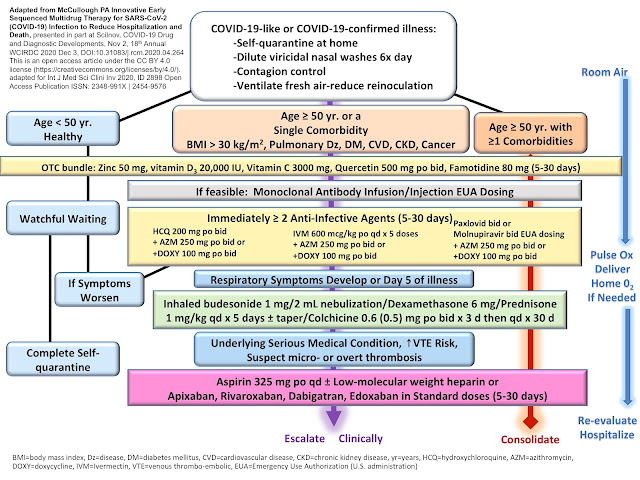
Dr. Peter McCullough is an internist, cardiologist, epidemiologist, a full professor of medicine at Texas A&M College of Medicine in Dallas, USA. He also has a master's degree in public health and is known for being one of the top five most-published medical researchers in the United States and is the editor of two medical journals. McCullough Protocol 2022 Update: Azelastine Nasal Spray for Prevention of SARS-CoV-2 Infections: A Phase 2 Randomized Clinical Trial ( JAMA 2025 ) Everyone is familiar with nasal and oral swab testing for COVID-19. It should be obvious the virus is replicating in the nose, and with Omicron, the speed of replication has become much greater than the prior strains of the virus. Thus, there is a wonderful opportunity to reduce viral replication, in fa...

9 Best Anti-COVID Nasal Sprays (2026)

Image
Do nasal sprays actually work against COVID-19? There has been quite a lot of activities in the COVID nasal spray space.  Two old-school nasal sprays—one antihistamine (azelastine) and one seaweed-derived barrier (iota-carrageenan)—now have randomized human data suggesting they can lower the risk of infection when used regularly during high exposure events (such as air travel, parties, etc). Below, we look at some of the best nasal sprays for COVID-19 and summaries of the rationale and evidence for each category. Do note that some of them are available as an over-the-counter medication but some are still under clinical trial stage. Best Nasal Sprays for COVID-19 There are lots of great nasal sprays out there, and this list is by no means complete. We’ve included nasal sprays with proven anti-COVID-19 ingredient, you can buy over the counter or online. 1. Povidone   Iodine Nasal Spray   and COVID-19 Povidone...

Povidone-Iodine for SARS-CoV-2 Nasopharyngeal Decontamination: Updated Evidence (2020–2026)

Image
Abstract Background: Povidone-iodine (PVP-I) has been proposed as a topical antiviral intervention targeting SARS-CoV-2 replication in the nasopharynx. While early pandemic recommendations were largely mechanistic, recent studies (2024–2025) provide more structured clinical evidence. Objective: To evaluate updated clinical efficacy, safety, and translational relevance of PVP-I nasal and oral applications in COVID-19. Methods: Narrative review of in vitro studies, randomized controlled trials (RCTs), and systematic reviews published between 2020 and 2025. Results: Recent meta-analysis (2025) suggests PVP-I reduces viral load compared with controls, though effects are modest and not always statistically significant. Randomized trials (2024) confirm shortened viral clearance time but no clear reduction in severe outcomes. Evidence from a 2025 phase III trial in upper respiratory infections supports antiviral activity in real-world viral illnesses. ...

Dr Peter McCullough: Nasal Spray and Mouth Gargle to stop COVID?

Image
Dr. Peter McCullough has impeccable academic credentials. He's an internist, cardiologist, epidemiologist, a full professor of medicine at Texas A&M College of Medicine in Dallas. He also has a master's degree in public health and is known for being one of the top five most-published medical researchers in the United States and is the editor of two medical journals. Dilute Povidone Iodine or Betadine (a 1% solution) gargling and as a nasal spray on a regular basis twice a day for prevention and then if you have been exposed or are in early stages use at least 4 or potentially 6 times a day. You can also use dilute hydrogen peroxide or dilute sodium hypo chloride or even Scope or Listerine – obviously do not swallow and spit out. Updates:  Efficacy and Advantages of Nasopharyngeal and Oropharyngeal Treatments for Early Intervention and Prophylaxis in Respiratory Viral Infections : A Systematic Review and Meta-Analysis (2025) How to Detox Sp...

Bird Flu 2025: Rising Threats, Human Cases, and Expert Prevention Strategies

Image
The recent emergence and spread of avian influenza strains, notably H5N1 and H7N9, have raised significant concerns among health experts and the public alike. These viruses, traditionally confined to bird populations, have begun infecting mammals, including cattle and humans, prompting discussions about potential pandemic threats and preventive measures. Transmission from Birds to Mammals Historically, avian influenza viruses primarily affected bird species. However, recent reports indicate that these viruses have crossed species barriers, infecting mammals such as cattle, sea lions, dolphins, and seals. In the United States, the H5N1 strain has been detected in dairy cattle, leading to significant outbreaks and raising concerns about human infections. While human cases remain rare and have not resulted in human-to-human transmission, the potential for the virus to adapt further poses a serious threat. ( Houston Chronicle ) Recent Human Cases and Mortality The first human death fro...

Dr Peter McCullough: Anti-Influenza Virus Activity of Povidone-Iodine Products (2025)

Image
Broad Killing Power Against H5, H7 and H9 Avian Influenza A Viruses with Nasal and Throat Sprays A new outbreak of H7N9 avian influenza in the U.S ., has been detected on a farm of 47,654 commercial broiler breeder chickens in Noxubee, Mississippi, March 13, 2025, as the Paris-based World Animal Health Organisation said in a report on Monday, citing U.S. Authorities. H7N9 is thought to be considerably more deadly than H5N1. I wondered if standard-of-care nasal and throat sprays and gargles with dilute povidone iodine would continue to have protective effects. Hiroshi Ito, Toshihiro Ito, Muneo Hikida, Junko Yashiro, Akira Otsuka, Hiroshi Kida, Koichi Otsuki; Outbreak of Highly Pathogenic Avian Influenza in Japan and Anti-Influenza Virus Activity of Povidone-Iodine Products. Dermatology 1 February 2006; 212 (Suppl. 1): 115–118. https://doi.org/10.1159/000089210 Ito et al reported in in 2006: The in vitro antiviral activity of PVP-I products (2% PVP-I solution, 0.5% PVP-I scrub, 0.25% PV...

Labels

Show more

Archive

Show more