Legionnaires Outbreak in New York: Legionella in Industrial and Commercial Cooling Towers (2026)

Understanding how Legionella colonizes cooling towers, the health risks associated with exposure, and the regulatory standards required for compliance is essential for facility managers, building operators, and environmental health specialists.

What is Legionella and Why Do Cooling Towers Pose a Unique Threat?
Legionella pneumophila is a waterborne bacterium found naturally in fresh water environments. While low levels in natural water bodies rarely cause illness, warm, stagnant, and nutrient-rich water systems provide optimal conditions for rapid bacterial amplification.
Cooling towers are particularly susceptible due to three core factors:
- Optimal Water Temperature: Legionella thrives in water temperatures between 68°F and 122°F (20°C to 50°C), which matches the typical operating range of heat rejection equipment.
- Aerosol Generation: Cooling towers rely on evaporation and drift, creating fine water mist or aerosols. If the water is contaminated, these airborne droplets can carry the bacteria over significant distances.
- Biofilm and Scale Accumulation: Organic matter, scale, rust, and sediment inside cooling tower basins act as protective shields and food sources for Legionella colonies.
Key Health and Regulatory Compliance Standards
Outbreaks originating from cooling towers often make headlines due to the high volume of people potentially exposed in short timeframes. As a result, health authorities around the globe enforce strict guidelines and standards for water safety management:
1. ASHRAE Standard 188
ASHRAE Standard 188 outlines the minimum Legionellosis risk management requirements for building water systems. It requires facility managers to implement a formal Water Management Program (WMP) to continuously monitor and control chemical and biological risks.
2. CDC Toolkit and Guidelines
The Centers for Disease Control and Prevention (CDC) provides comprehensive toolkits on developing water safety plans, identifying high-risk areas, and establishing corrective actions when Legionella levels spike.
3. Local Environmental Regulations
Many jurisdictions mandate regular registration, routine testing, and third-party auditing of cooling tower systems to prevent community-wide outbreaks.
Essential Steps for Legionella Control and Prevention in Cooling Towers
Maintaining a clean, compliant cooling tower requires a proactive, multi-layered approach rather than relying solely on reactive treatments when bacteria are detected.
1. Implement Continuous Biocidal Treatment
Utilize a dual-biocide program combining oxidizing biocides (such as chlorine or bromine) with non-oxidizing biocides. This prevents bacteria from developing resistance and disrupts the formation of protective biofilm layers on tower surfaces.
2. Routine Physical Maintenance & Cleaning
- Inspect and Clean Basins: Remove sludge, scale, and organic debris at least twice a year.
- Inspect Drift Eliminators: Ensure drift eliminators are intact and functioning properly to minimize aerosol emissions.
- Eliminate Dead Legs: Remove stagnant pipework sections where water circulation is minimal or non-existent.
3. Establish a Regular Testing Schedule
Conduct routine microbiological testing (e.g., Dipslides for total bacterial count) along with periodic, lab-accredited Legionella PCR or culture testing to verify the effectiveness of your water treatment program.
What to Do If Legionella Is Detected in Your System
If testing reveals elevated levels of Legionella, immediate corrective action is mandatory to safeguard public health:
- Isolate and Disinfect: Initiate an emergency shock hyperchlorination process in accordance with OSHA or CDC emergency disinfection protocols.
- Re-test the System: Conduct follow-up testing several days after disinfection to ensure the bacterial load has dropped below safety thresholds.
- Review and Adjust the WMP: Investigate root causes—such as chemical feed pump failures, dosing changes, or recent system shutdowns—and update your maintenance plan accordingly.
What Makes Legionnaires’ So Dangerous but Treatable
Legionella pneumophila is a gram-negative bacillus that thrives in warm, stagnant water. Cooling towers, hot tubs, shower heads, decorative fountains—anywhere water aerosolizes, Legionella can hitch a ride straight into your lungs. It is not contagious person-to-person. You cannot get it from drinking contaminated water. The infection occurs exclusively through inhalation of contaminated mist or vapor.Once inside the lungs, the bacteria invade and multiply within alveolar macrophages—the very immune cells meant to destroy them. The resulting pneumonia presents with fever, chills, muscle aches, cough, and often extrapulmonary symptoms including confusion, headache, and diarrhea. Standard empiric antibiotic regimens for community-acquired pneumonia may not cover Legionella adequately if the wrong agents are chosen.
A patient walks into an ER with fever, cough, and shortness of breath. It takes hours to be seen and get a chest x-ray. If that first azithromycin dose is delayed, underdosed, or omitted from the empiric regimen, the patient deteriorates while the lab runs its urine antigen test—a test that, critically, only detects L. pneumophila serogroup 1, missing roughly 30–40% of Legionella infections caused by other serogroups and species.
The urine antigen test takes hours to days. The culture on buffered charcoal yeast extract agar takes three to five days. PCR is faster but not universally available. By the time the diagnosis is confirmed, a patient on inadequate empiric therapy may already be decompensating.
The Treatment
Azithromycin: Outpatient
Azithromycin (e.g. Zithromax) is highly effective and is the macrolide of choice. It achieves concentrated intracellular levels, has a long half-life allowing once-daily dosing, and for mild-to-moderate disease in immunocompetent patients, a 5–10 day course gets the job done. Clarithromycin and erythromycin are inferior alternatives—less well-tolerated, more drug interactions, and frankly, azithromycin has largely rendered them obsolete for this indication.Fluoroquinolones: Inpatient
Levofloxacin or moxifloxacin are the preferred agents—particularly for hospitalized patients, immunocompromised patients, and severe disease. They achieve excellent intracellular penetration, high bioavailability allowing oral step-down therapy, and bactericidal activity against Legionella. A typical course runs 7–14 days, extending to 3 weeks for the severely immunocompromised.Alternative: Doxycycline
For mild pneumonia in immunocompetent patients who cannot tolerate macrolides or fluoroquinolones, doxycycline is a reasonable alternative. It achieves adequate intracellular levels and covers Legionella, though it is generally considered second-tier compared to azithromycin and the respiratory fluoroquinolones.The Wellness Company Medical Emergency Kit: Pre-prescribed Antibiotics, One Box
The Wellness Company—a private entity operating entirely outside the government bureaucracy—has put together a Medical Emergency Kit containing azithromycin and doxycycline, the precise duo of antibiotics that cover Legionella pneumophila, and made it available to any American with the foresight to spend less than the cost of a single urgent care co-pay.Legionnaires’ treatment:
- Azithromycin (Generic Z-Pak): First-line macrolide; 5–10 day course for mild-moderate disease
- Doxycycline: Broad-spectrum tetracycline, alternative for mild pneumonia in immunocompetent patients.
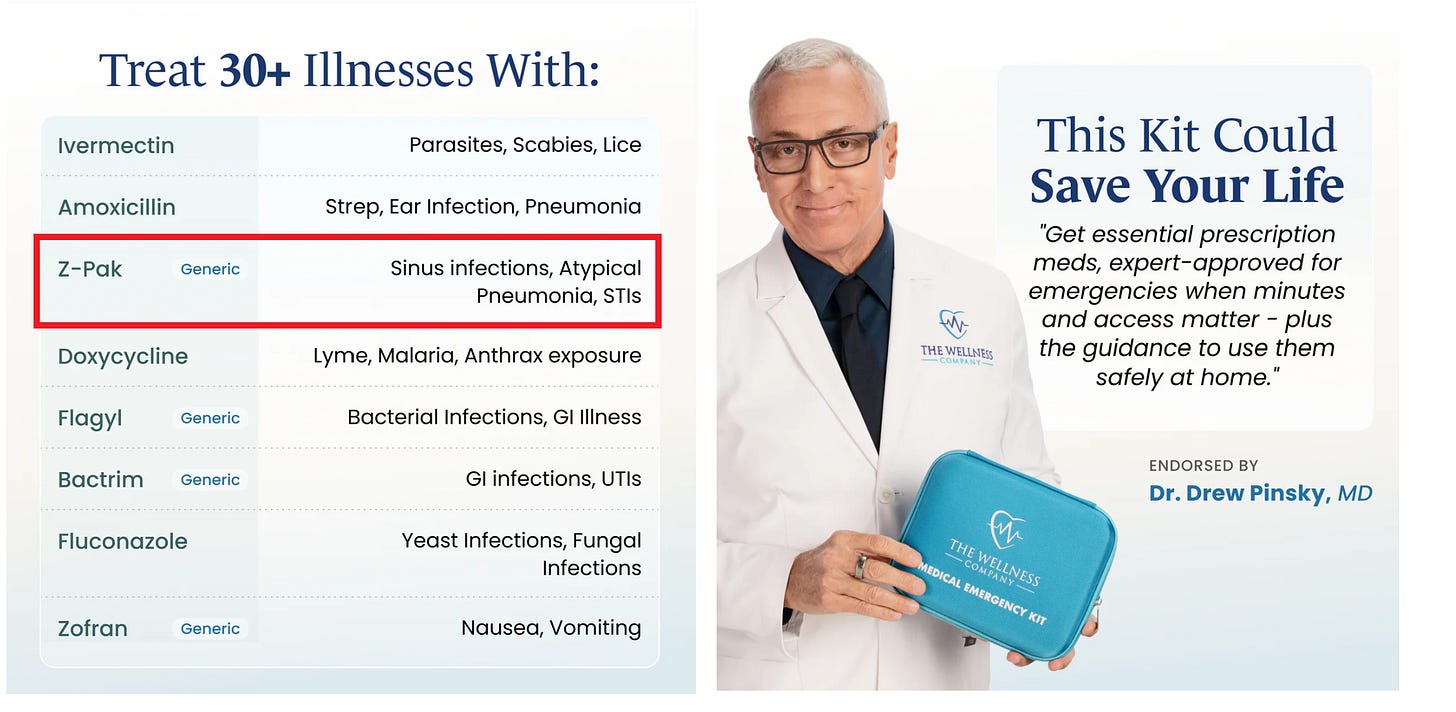
The kit also includes amoxicillin-clavulanate, cephalexin, and TMP-SMX (for Cyclosporiasis)—not directly indicated for Legionella, but critical for the broader landscape of bacterial infections that someone might face while the healthcare system is overwhelmed with an outbreak.
To illustrate the potential value of preparedness, consider the following scenario:
Imagine you are a 55-year-old man living on Manhattan's Upper East Side. You smoke. You wake up with a fever of 102°F (38.9°C), chills, a persistent cough, and severe muscle aches. News reports indicate that dozens of nearby buildings have tested positive for Legionella-contaminated cooling towers. You call your primary care physician, but the earliest available appointment is three days away. At an urgent care clinic, you test negative for influenza and COVID-19 and are advised to rest, stay hydrated, and monitor your symptoms. Over the next day, your condition worsens.
Without immediate access to appropriate treatment: You continue to deteriorate, eventually developing severe pneumonia that requires emergency hospitalization. You receive intravenous antibiotics while clinicians evaluate the possibility of Legionnaires' disease and await confirmatory testing.
With appropriate physician-guided access to recommended antibiotics: Recognizing the combination of fever, cough, muscle aches, and known local exposure risk, you promptly consult a licensed healthcare provider and begin an antibiotic regimen appropriate for suspected Legionnaires' disease. Early treatment can reduce the risk of severe illness and hospitalization, and many patients recover without requiring inpatient care.
Although individual outcomes vary and no treatment guarantees recovery, early recognition and timely initiation of appropriate antibiotics are well-established factors associated with better outcomes in Legionnaires' disease. During an outbreak—when access to healthcare may be delayed—having physician-prescribed medications readily available, together with prompt medical guidance, may provide a meaningful advantage for eligible patients.
References:
- https://www.nyc.gov/site/doh/health/health-topics/legionnaires-disease.page
- https://www.thefocalpoints.com/p/cooling-towers-full-of-legionella
- https://legionella.org/about-the-disease/what-is-legionnaires-disease/treatment/
- https://pmc.ncbi.nlm.nih.gov/articles/PMC9124264/
- https://preventlegionnaires.org/legionnaires-disease-treatment/




Comments
Post a Comment