Posts

Showing posts with the label NAC

NAC: Is this the one supplement everyone should be taking?

Image
The nutritional supplement N-acetylcysteine is like the Swiss Army knife of supplements. It’s used to treat a wide range of health conditions, including allergies, Alzheimer disease, bipolar disorder, bronchitis, chronic kidney disease, cirrhosis, heart disease, hepatitis, infertility, schizophrenia, and upper respiratory infections. The nutritional supplement N-acetylcysteine is used to treat a wide range of health conditions. Then again, many dietary supplements are believed to have a variety of uses. The big question is whether they actually work. To answer that question, here’s some of the research that supports a few of the many uses of N-acetylcysteine. Contents What is N-acetylcysteine? Acetaminophen toxicity High blood pressure COPD PCOS NAFLD (Non Alcoholic Fatty Liver Disease) COVID-19? NAC Also Protects Against Blood Clots Standard of Care for COVID-19 Shou...

Simulated Clinical Trial for Nattokinase, Curcumin, Bromelain, and Ivermectin for Long COVID or Spike Protein Syndrome (2025)

Image
Currently, there are no published simulated clinical trials (e.g., in silico clinical trial models or virtual patient cohort studies) specifically evaluating the combination of nattokinase, curcumin, bromelain, and ivermectin for Long COVID or spike protein syndrome. However, in silico studies, in vitro research, and observational data provide a foundation for designing such a trial. Below, we outline a hypothetical framework for a simulated clinical trial based on existing evidence, proposed mechanisms, and computational modeling approaches. This framework incorporates insights from in silico and preliminary studies, addresses gaps, and aligns with the query's focus on Long COVID and spike protein-related syndromes. Simulated (In Silico) Clinical Trial Design Objective: To evaluate the efficacy and safety of a combination regimen of nattokinase, curcumin, bromelain, and ivermectin in reducing symptoms of Long COVID or spike protein syndrome (e.g., fatigue, brain fog, cardiovascula...

Quercetin, Bromelain and NAC for COVID (2024)

Image
Quercetin , a natural anti-oxidant, anti-inflammatory and  anti-blood clot  compound contained in abundance in various fruits and vegetables, is a zinc ionophore. The major benefit of taking quercetin with zinc is that the quercetin will push the zinc into the center of the cell where the zinc can stop the virus from reproducing. Additionally, Quercetin has been shown to be a potent inhibitor of coronaviruses by inhibiting cellular entry as well as inhibiting proinflammatory cytokines. One of the hallmarks of COVID-19 is an imbalanced immune response cascading to cytokine storms and then hyper inflammation which then can lead to acute respiratory distress syndrome (ARDS).  Quercetin has been shown to inhibit proinflammatory cytokine production as well as inflammation due to its antioxidant properties, amongst others. By inhibiting destructive inflammation and potentially the entire cascade, quercetin may prevent severe damage to the respiratory system amongst other o...

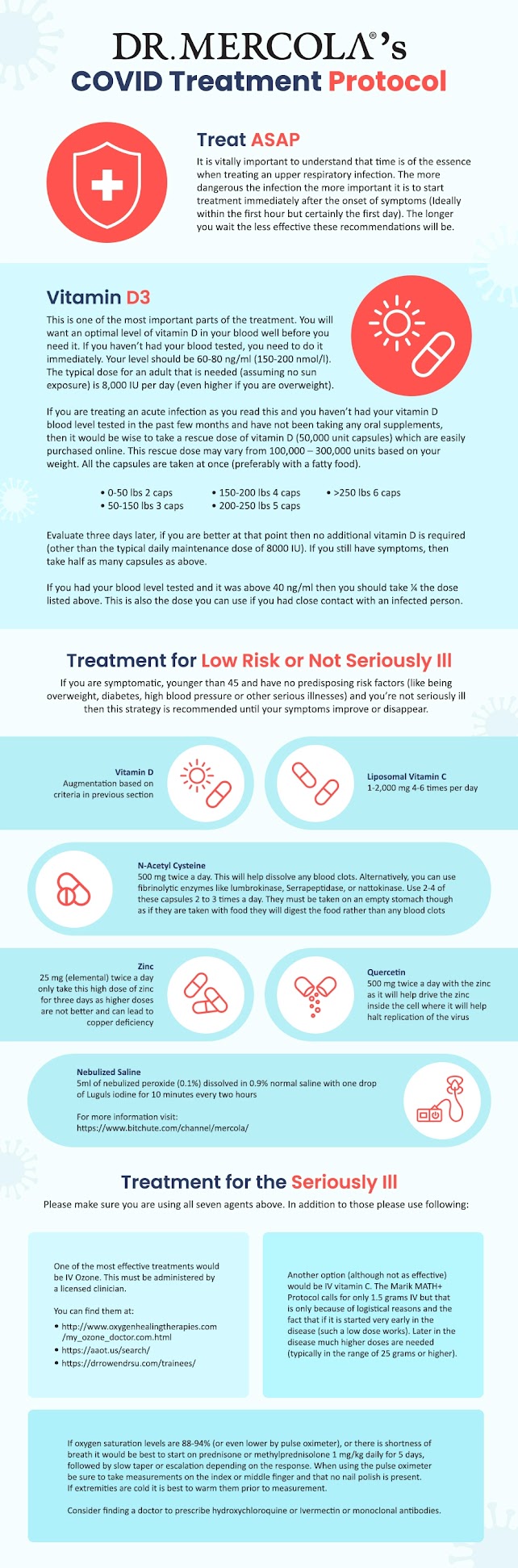
Dr Mercola's COVID Treatment Protocol

Image
Considering the uncertainties around diagnosis, it's best to treat any cold or flu-like symptoms early. At first signs of symptoms, start treatment. Perhaps it's the common cold or a regular influenza, maybe it's the much milder Omicron, but since it's hard to tell, your best bet is to treat symptoms as you would treat earlier forms of COVID. Considering how contagious Omicron is, chances are you're going to get it, so buy what you'll need now, so you have it on hand if/when symptoms arise. And, remember, this applies for those who have gotten the jab as well, since you're just as likely to get infected — and perhaps even more so. Early treatment protocols with demonstrated effectiveness include: The Front Line COVID-19 Critical Care Alliance's (FLCCC's) prevention and early at-home treatment protocol. They also have an in-hospital protocol and long-term management guidance for long-haul COVID-19 syndrom...

Does NAC Prevent Cytokine Storm in COVID-19?

Image
N-acetylcysteine ( NAC )  is a precursor to glutathione. It is an antioxidant and increases glutathione levels in the body  ( Source ).  NAC has a long history of use as a first-aid remedy for acetaminophen poisoning. It neutralizes the toxic effects of the drug by recharging glutathione, thereby preventing liver damage. NAC may be able to inhibit Cytokine Storm Researchers have confirmed that in severe COVID-19 cases, cytokines such as interleukin-6 (IL6), interleukin-10 (IL10) and TNF-É‘ are all elevated. Once they reach excessive levels, a so-called cytokine storm develops, causing significant tissue damage. NAC may be able to inhibit this damaging cascade. In the " Therapeutic Blockade of Inflammation in Severe COVID-19 Infection With Intravenous N-acetylcysteine " paper, the researchers focus on a specific group of patients, namely those with glucose 6-phosphate dehydrogenase (G6PD) deficiency, which has been shown to facilitate human coronavirus infection due to the...

Mysterious Hepatitis Cases in Children: Acute Hepatitis of Unknown Origin 2022

Image
Outbreak at a glance: Since the WHO Disease Outbreak News on  Acute hepatitis of unknown aetiology – the United Kingdom of Great Britain and Northern Ireland  was published on 15 April 2022, there have been continuing further reports of cases of acute hepatitis of unknown origin among young children. It is not yet clear if there has been an increase in hepatitis cases, or an increase in awareness of hepatitis cases that occur at the expected rate but go undetected. While adenovirus is a possible hypothesis, investigations are ongoing for the causative agent. Outbreak overview On 5 April 2022, the International Health Regulations (IHR) National Focal Point (NFP) for the United Kingdom notified WHO of 10 cases of severe acute hepatitis of unknown aetiology in previously healthy young children (age range: 11 months to five-year-old) across central Scotland. Of these 10 cases, nine had onset of symptoms in March 2022 while one case had an onset of symptoms in January 2022.  S...

Labels

Show more