Nattokinase: What 46 Years of Research Actually Shows
Dose, blood pressure, carotid plaque, brain health and bleeding risk, graded by evidence tier. By Dr. Frank Yap, MD | Last Updated October 2026
Nattokinase is a clot-dissolving enzyme made by Bacillus subtilis during natto fermentation. Its best-supported human effect is a modest blood pressure drop (about 3 to 5 mmHg systolic) in randomized trials. Plaque regression has been reported only at 6,000 FU/day or higher, in studies that were unblinded or retrospective, while the largest placebo-controlled trial at 2,000 FU/day was null. No trial has measured heart attacks, strokes or deaths. It acts on clotting, so it should not be combined with blood thinners without a clinician, and it must never replace a prescribed anticoagulant.
Contents
- What nattokinase is
- How it works
- Human evidence table (CEBM tiers)
- Blood pressure
- Plaque and the dose question
- Cholesterol
- Brain and stroke research
- Spike protein claims
- Natto the food vs. the enzyme
- Safety, interactions and who should avoid it
- Dose and label checklist
- Evidence gaps
- FAQ
- AI personalization guide
- References
1. What Nattokinase Is
In 1980, Japanese researcher Hiroyuki Sumi, working at the University of Chicago, noticed that natto, a fermented soybean food eaten in Japan for centuries, dissolved artificial fibrin clots. His 1987 paper named the responsible enzyme nattokinase [1]. Despite the name, it is not a kinase. It is a subtilisin-family serine protease of 275 amino acids produced by the bacterium, not by the soybean [2]. That is why raw soy contains none.
Potency is expressed in fibrinolytic units (FU), not milligrams. A typical 100 mg capsule is labeled around 2,000 FU [3].
2. How It Works
Most of the mechanism data comes from test tubes, cells and animals (CEBM Tier 5). The proposed actions are:
- Direct fibrin cleavage. In a rat carotid thrombosis model it restored more arterial flow than an equimolar dose of plasmin [4].
- PAI-1 inactivation. PAI-1 is the brake on your own clot-dissolving system; nattokinase cleaves it in vitro [2].
- Platelet and viscosity effects in animal and blood-sample work.
- ACE inhibition by the enzyme and its peptide fragments, a plausible route to lower blood pressure.
Does an oral protein survive digestion? Partly. Nattokinase was detectable in human serum after a single 2,000 FU capsule [3], and in a double-blind crossover of 12 healthy men the same dose shifted D-dimer, factor VIII, antithrombin and aPTT within hours, all inside normal ranges [5]. That shows a real biological effect, not a clinical benefit.
3. Human Evidence at a Glance
CEBM tiers: 1 = systematic review of RCTs; 2 = individual RCT; 3 = non-randomized or unblinded cohort; 4 = case report or series; 5 = mechanism, animal or in-vitro. Scroll sideways on mobile.
| Study | Design / n | Daily dose | Main finding | Tier |
|---|---|---|---|---|
| Kim 2008 [6] | RCT, n=86, 8 wk | 2,000 FU | Net SBP −5.55, DBP −2.84 mmHg vs placebo | 2 |
| Jensen 2016 [7] | RCT, n=79, 8 wk | 2,000 FU | Diastolic fell about 3 mmHg; placebo flat | 2 |
| Li 2023 [8] | Meta-analysis, 6 RCTs, n=546 | Various | SBP −3.45, DBP −2.32 mmHg; lipids not improved at low dose | 1 |
| Hodis 2021 (NAPS) [9] | RCT, n=265, 3 yr, healthy adults | 2,000 FU | No effect on carotid thickness, stiffness or labs | 2 |
| Ren 2017 [10] | Randomized vs simvastatin 20 mg, n=82, no placebo, 26 wk | 6,000 FU | Plaque −36.6% vs −11.5% on statin | 3 (no placebo) |
| Chen 2022 [11] | Retrospective, n=1,062 (683 imaged), 12 mo | 10,800 FU (3,600 FU arm: no effect) | Plaque −36%, IMT −21.7% | 3 |
| Hsia 2009 [12] | Open-label, n=45, 2 mo | 4,000 FU | Fibrinogen and factors VII/VIII fell | 3 |
| Cesarone 2003 [13] | RCT, n=204, long-haul flights | Combined with pine bark | 0 DVT treated vs 5 controls; combination, not nattokinase alone | 2 |
| Liu 2024 [14] | RCT, n=178, stable CAD, 90 d | With red yeast rice | Best lipid and BP results in the combination arm | 2 |
| ICC-PACS 2026 [15] | RCT, n=120, 6 mo | 8,000 FU | Global MoCA unchanged; visuospatial gain in exploratory analysis | 2 |
| Nagata 2017; Katagiri 2020 [16] [17] | Cohorts, 29,079 and 92,915 adults | Natto food, not supplement | Higher natto intake linked to lower cardiovascular mortality | 3 |
4. Blood Pressure: The Best-Supported Effect
Two independent randomized trials, one Korean and one North American, found small but consistent reductions at the standard 2,000 FU dose [6] [7]. A 2023 meta-analysis of six trials pooled them to about 3.5 mmHg systolic and 2.3 mmHg diastolic [8]. That is a modest effect, smaller than a standard antihypertensive, and trials were short and small. If you already take blood pressure medication, the effect is additive, so tell your prescriber.
5. Plaque and the Dose Question
This is the most discussed and most over-read claim. The pattern across human carotid studies looks like a dose-response curve:
- 2,000 FU/day for 3 years, placebo-controlled: no effect [9].
- 3,600 FU/day for 12 months: no effect [11].
- 6,000 FU/day for 26 weeks: plaque fell more than with simvastatin 20 mg [10].
- 10,800 FU/day for 12 months: plaque and IMT fell [11].
6. Cholesterol
At standard doses nattokinase alone did not lower lipids in a six-month randomized trial, while a nattokinase plus red yeast rice formula did [19]. The 2023 meta-analysis likewise found no lipid benefit at low doses [8]. Treat lipid-lowering as inconsistent, and note that red yeast rice contains monacolin K, a statin-like compound with its own interaction and side-effect profile. It is not a substitute for guideline-based lipid care.
7. Brain and Stroke Research
Rodent studies report smaller stroke infarcts, less neuroinflammation and better memory outcomes (Tier 5). In humans, the ICC-PACS trial randomized 120 adults with asymptomatic intracranial or carotid stenosis to 8,000 FU/day or placebo for six months. The registered primary outcome was the change in MoCA global cognition (NCT05200234), and the published report states this did not differ; a visuospatial improvement appeared in an exploratory analysis [15]. Treat that as a hypothesis to test, not a cognitive benefit. We could not independently confirm the full paper at the time of writing, so check the abstract before quoting it.
8. Spike Protein Claims
Two laboratory studies showed that nattokinase or natto extract degrades SARS-CoV-2 spike protein in cell systems, with controls consistent with a protease mechanism [20] [21]. That is Tier 5 evidence. No controlled human trial shows that oral nattokinase clears spike protein or treats long COVID or post-vaccination syndromes, and a protein in a dish is not the same as an effect in tissue. Anyone with persistent symptoms should have clotting, cardiac and neurological causes evaluated rather than self-treating with a fibrinolytic enzyme.
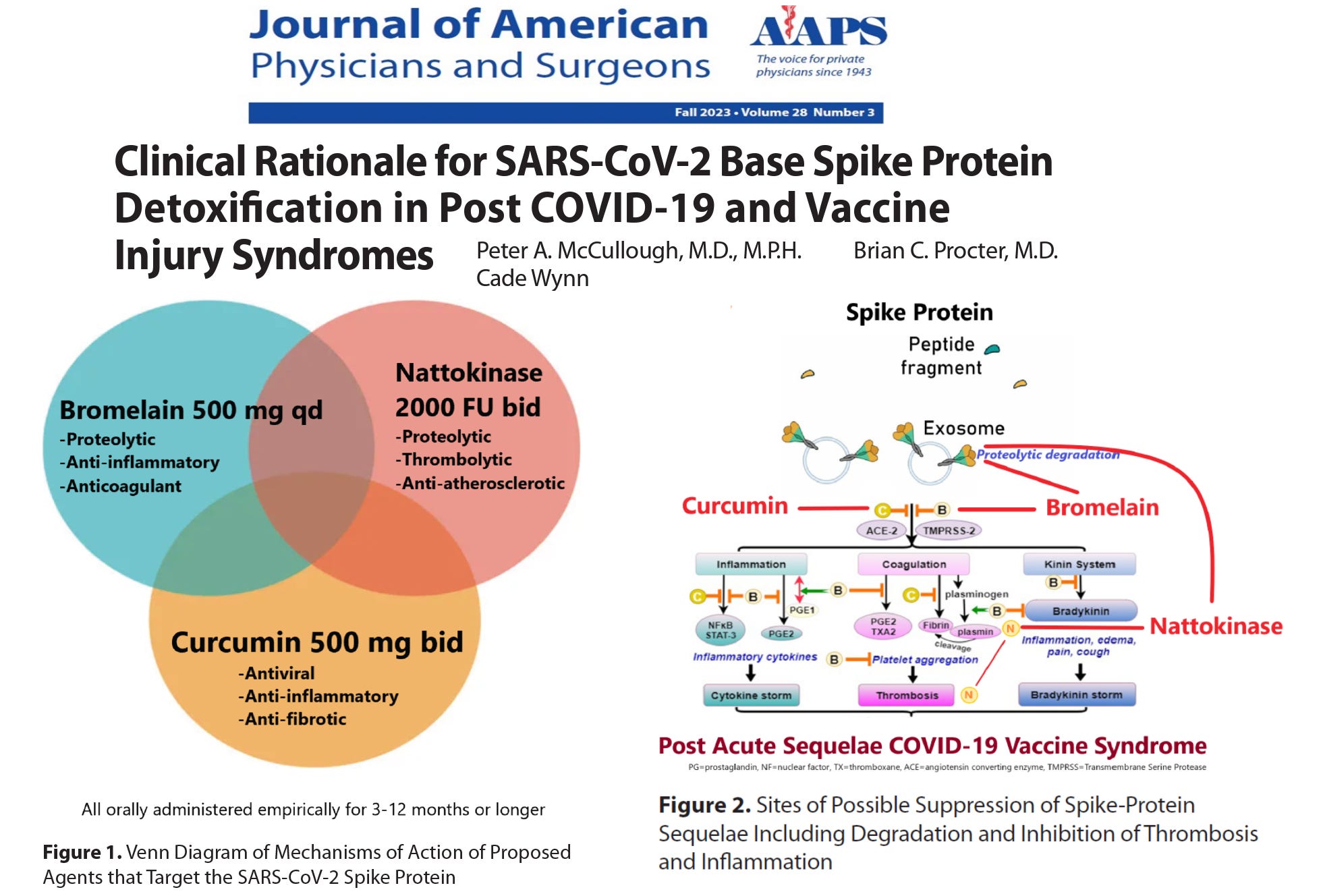 |
| McCullough PA, Wynn C, Procter BC. Clinical Rationale for SARS-CoV-2 Base Spike Protein Detoxification in Post COVID-19 and Vaccine Injury Syndromes. Journal of American Physicians and Surgeons Volume 28 Number 3 Fall 2023, 90-93. |
9. Natto the Food vs. the Enzyme
In the Takayama Study, the highest natto intake quartile had about 25% lower cardiovascular mortality over 16 years [16]. The Japan Public Health Center cohort reported similar patterns for fermented soy [17]. These are observational (Tier 3): natto eaters differ in diet, region and lifestyle, and natto also supplies vitamin K2 and other nutrients. The cohorts measured the food, so they cannot be credited to nattokinase capsules.
10. Safety, Interactions and Who Should Avoid It
Animal toxicology is reassuring [22], and trials and a 153-patient surgical series reported no adverse drug reactions [23]. But those studies were small and short, and no surveillance system tracks nattokinase. Published case reports (Tier 4) show the real risk:
- A cerebellar hemorrhage in a patient on aspirin with cerebral microbleeds, after one week of nattokinase [24].
- A fatal hemoperitoneum in an elderly woman taking nattokinase [25].
- Valve thrombosis in a mechanical-valve patient who swapped warfarin for nattokinase [26].
One more interaction: natto food is rich in vitamin K2 (MK-7), which opposes warfarin. Many nattokinase capsules are K2-free; food and capsule are different interactions, and both need the prescriber informed.
11. Dose and Label Checklist
- Read FU, not mg. Compare products by fibrinolytic units per serving.
- Stay at or near the label dose (commonly 2,000 FU). Higher doses used in studies were supervised and have no established long-term safety margin.
- Check for vitamin K2 if you take warfarin.
- Look for third-party testing (USP, NSF or ConsumerLab-style verification) and a stated FU assay.
- Skip proprietary blends that hide the nattokinase amount.
Browse options: nattokinase supplements on Amazon (affiliate link). Listing here is not an endorsement.
12. Evidence Gaps
- A placebo-controlled, dose-ranging plaque trial in people who actually have plaque.
- Any hard-outcome trial counting heart attacks, strokes or deaths.
- Controlled human data on spike protein, long COVID or post-vaccination syndromes.
- Long-term bleeding surveillance in older adults on polypharmacy.
A 2026 review noted that limited clinical evidence and lack of standardization are what hold back clinical use [28].
13. Frequently Asked Questions
What does nattokinase do?
It breaks down fibrin, inactivates PAI-1 and shifts clotting markers in lab and small human studies. Its best-supported clinical effect is a small blood pressure reduction.
Does nattokinase reduce arterial plaque?
Possibly at 6,000 FU/day or more, but the supporting studies were unblinded or retrospective, and the largest placebo-controlled trial at 2,000 FU/day was null.
What is a safe nattokinase dose?
No official upper limit exists. Most trials used 2,000 FU/day. Use higher doses only under clinician oversight.
Can I take nattokinase with blood thinners?
Not without medical supervision. Case reports describe serious bleeding with combined antithrombotic use, and it must never replace an anticoagulant.
Is natto the same as nattokinase supplements?
No. Natto is a food with vitamin K2; many capsules are K2-free, so interactions differ.
Does nattokinase remove spike protein?
It degrades spike protein in laboratory systems only. No controlled human trial supports clinical use for post-COVID or post-vaccination conditions.
14. AI Personalization Guide
Paste your medication list and conditions into an AI assistant to prepare for a clinician visit. Treat outputs as discussion prompts, and verify against your pharmacist.
| Assistant | Best use | Sample prompt |
|---|---|---|
| Claude | Weighing study quality and trade-offs | "Here are my medications. List the interaction questions I should ask my doctor about nattokinase, and rate the evidence for each." |
| ChatGPT | Visit-prep checklists and plain-language summaries | "Summarize the nattokinase blood pressure trials in plain language and draft five questions for my cardiologist." |
| Gemini | Comparing product labels and units | "Convert these two supplement labels to FU per serving and flag any that contain vitamin K2." |
| Perplexity | Finding new trials and checking citations | "Find randomized trials of nattokinase published since 2025 and show each primary outcome with sources." |
15. References
- Sumi H et al. Experientia 1987. PubMed
- Urano T et al. J Biol Chem 2001. PubMed
- Ero MP et al. Altern Ther Health Med 2013. PubMed
- Fujita M et al. Biol Pharm Bull 1995. PubMed
- Kurosawa Y et al. Sci Rep 2015. PMC
- Kim JY et al. Hypertens Res 2008. PubMed
- Jensen GS et al. Integr Blood Press Control 2016. PMC
- Li D et al. Rev Cardiovasc Med 2023 (meta-analysis). PMC
- Hodis HN et al. Clin Hemorheol Microcirc 2021 (NAPS). PubMed
- Ren NN et al. Zhonghua Yi Xue Za Zhi 2017. PubMed
- Chen H et al. Front Cardiovasc Med 2022. PMC
- Hsia CH et al. Nutr Res 2009. PubMed
- Cesarone MR et al. Angiology 2003. PubMed
- Liu et al. Front Nutr 2024. PMC
- Zhang et al. J Stroke Cerebrovasc Dis 2026 (ICC-PACS); registry NCT05200234. PubMed | ClinicalTrials.gov
- Nagata C et al. Am J Clin Nutr 2017. PubMed
- Katagiri R et al. BMJ 2020. PMC
- Corrigendum to Chen et al. 2022. PMC
- Yang NC et al. Asia Pac J Clin Nutr 2009. PubMed
- Tanikawa T et al. Molecules 2022. PMC
- Oba M et al. Biochem Biophys Res Commun 2021. PMC
- Lampe BJ, English JC. Food Chem Toxicol 2016. PubMed
- Gallelli L et al. Nutrients 2021. PMC
- Chang CH et al. Intern Med 2008 (case report). PubMed
- Ramachandran et al. Cureus 2021 (case report). PMC
- Elahi MM et al. Proc Bayl Univ Med Cent 2015 (case report). PMC
- Suzuki et al. Allergol Int 2023 (Bac s 1 allergen). PubMed
- Ma et al. Life Sci 2026 (review). PubMed
- Secondary commentary reviewed (not used as a primary source): Ji S. "The Undeniable Power of Nattokinase," Substack, Oct 22, 2026. The author discloses a financial interest in a natto supplement. Link



Comments
Post a Comment