In this breaking interview, Dr. Takuji Shirasawa from the Ochanomizu Health and Longevity Clinic describes a 60-year old Japanese man who took 4 Pfizer COVID-19 vaccines and presented with a loss of mental clarity otherwise known as “brain fog.” Shirasawa used MR angiography to demonstrate sessile bilateral arterial thrombi in the carotid bulbs. His hypothesis was that mini-blood clots may be responsible for the neurological and cognitive symptoms.
Shirasawa performed a N-of-1 trial giving the patient a complex blend of oral proteolytic and thrombolytic enzymes featuring nattokinase, bromelain, serrapeptase, and papain adding over a dozen natural ingredients given in proprietary blends from Texas based Phytomedic Labs. The patient was also administered aspirin 100 mg per day.
Serial d-dimer levels showed a spike in concentration as the blood clots were lysed and shown to resolve over serial MR angiographic scans with virtual angioscopy. As the blood clots disappeared the patient’s brain fog lifted. I can tell you as a cardiologist these images are stunning.
First-in-man reports are very important in medicine. Such reports for coronary angioplasty and stenting changed medical history. Dr. Shirasawa’s case may have a similar historical impact as the medical community is even better supported with the mechanistic rationale for McCullough Protocol Base Spike Detoxification and even more intensive protocols in the future.
Base Spike Detox According to Dr Peter McCullough (in a X/Twitter post): Base Spike Detox is what I am currently using in my practice for those who have had COVID-19 multiple times, one or more of the COVID-19 vaccines, or both and believe persistent SARS-CoV-2 Spike protein could be causing problems in their body. I have arrived, based on the emerging scientific literature (1) and my clinical observation, that three OTC products are essential as a triple base combination: Nattokinase 2000 FU (100 mg) twice a day Bromelain 500 mg once a day Nano/Liposomal Curcumin 500 mg twice a day Related: Nattokinase, Bromelain and Curcumin from The Wellness Company Additional products can be added, including NAC, IVM (Ivermectin), HCQ (Hydroxychloroquine), fluvoxamine, low-dose naltrexone, and blood thinners, depending on the clinical evaluation and the syndrome. The therapeut...
The Front Line COVID-19 Critical Care (FLCCC*) Alliance was initially formed as a working group during the early COVID-19 pandemic days in response to multiple early reports of COVID patients with an inexplicably high need for prolonged mechanical ventilation and an excessive death rate. *The FLCCC Alliance is now the Independent Medical Alliance Based on rapidly emerging clinical trials evidence, the FLCCC team has developed the I-MASK+ protocol ( is now divided into I-Prevent and I-Care protocols ) for prophylaxis and at home treatment of early stage COVID-19. Quercetin, zinc and a number of nutrients and drugs are part of this protocol, not only for critical care but also for prophylaxis and mild disease being treated at home. This article, we will dive deeper to provide the scientific background, related references and rationale of the FLCCC protocols. December 2025 Update: The Stratus Variant (XFG): Symptoms, Global Spread, and Impact in Late 2025 FLCCC ( ...
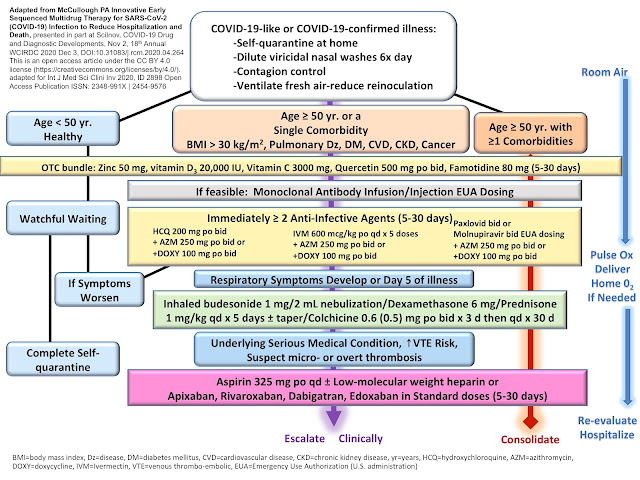
Dr. Peter McCullough is an internist, cardiologist, epidemiologist, a full professor of medicine at Texas A&M College of Medicine in Dallas, USA. He also has a master's degree in public health and is known for being one of the top five most-published medical researchers in the United States and is the editor of two medical journals. McCullough Protocol 2022 Updates: Double blind randomized controlled trial of saline solution gargling and nasal rinsing in COVID infection (Nov 2023) What really killed COVID-19 patients: It wasn't a cytokine storm, suggests study (2023) Everyone is familiar with nasal and oral swab testing for COVID-19. It should be obvious the virus is replicating in the nose, and with Omicron, the speed of replication has become much greater than the pr...
For years, clinicians and patients have described a disturbing pattern — cancers appearing suddenly, growing at unexpected speed, or diseases thought stable returning aggressively within weeks or months. A sudden rise in younger people with early onset cancers which are more aggressive with more (and unusual) genetic change has been increasingly noted - colorectal, breast and GI tract cancers seem to lead the way. Some called them “turbo cancers”. In oncology, the phenomenon is known as hyper-progression: cancers that accelerate far more rapidly than expected. Early on, these reports were ignored. They surfaced as scattered cases — isolated anecdotes that were easy to dismiss. One of the first to speak publicly was Belgian immunologist Michel Goldman, whose story was published in The Atlantic in 2022. He believed the Covid-19 vaccine may have accelerated his lymphoma. Shortly after vaccination and boosting, he developed swollen lymph nodes, fatigue and night sweats. Imaging revealed ...
A Guide to Diagnosing and Managing Influenza and Respiratory Syncytial Virus (RSV) Infections in Adults In adult patients, COVID-19 (Omicron variant), influenza, and RSV present with similar symptoms and can, therefore, be difficult to distinguish. This guide aims to help diagnose and treat Influenza and Respiratory Syncytial Virus (RSV). Update: Oseltamivir Treatment vs Supportive Care for Seasonal Influenza Requiring Hospitalization (JAMA 2025) For advice on how to protect yourself against infection, see I-PREVENT: COVID, Flu and RSV Protection Protocol . For treatment of COVID-19, see I-CARE: Early COVID Treatment Protocol . For treatment of Post Vaccine Complications, see I-RECOVER: Post Vaccine Treatment . Update: Added Minocycline (Jan 2023 update) Note that there are two I-Care Protocols; the I-Care Covid protocol to treat Covid and this protocol, I-Care Flu protocol. About this Protocol The information in this document is our recommended approach to COVID-19 ...
BY THOMAS E. LEVY, MD, JD As the acute cases of COVID have continued to decline, the prevalence of the Persistent Spike Protein (PSP) syndrome has continued to increase. The spike protein is that part of the COVID pathogen that attaches to ACE2 receptors throughout the body and permits the entry of the entire virus into the newly infected cell. There appear to be no cells, tissues, or organs in the body that are completely spared from this PSP attack once enough of it has been introduced into the body. The many mechanisms of action involved in the ultimate removal of spike protein. The persistent presence of the spike protein has been shown to be secondary to the inability to completely resolve a bout of COVID (chronic COVID or long-haul COVID) as well as the spike protein exposure from mRNA inoculation(s). And as more time has passed, the PSP syndrome following one or more mRNA shots has emerged as the most common reason for PSP, especially following a booster injection. Not surprisi...
Is povidone iodine the next ivermectin or hydroxychloroquine? Is there any evidence that povidone iodine can treat COVID-19? Iodine 1% Nasal Spray is part of the FLCCC I-CARE early treatment protocol : Nasal spray with 1% povidone-iodine: 2-3 times a day. Do not use for more than 5 days in pregnancy. If 1% product is not available, dilute the more widely available 10% solution and apply 4-5 drops to each nostril every 4 hours. Use 1 % povidone iodine commercial product as per instructions 2–3 x daily. If 1 %-product not available, must first dilute the more widely available 10 %-solution. To make 1% povidone iodine concentrated solution from 10% povidone iodine solution, one dilution method is as follows: – First pour 1½ tablespoons (25ml) of 10% povidone/ iodine solution into a nasal irrigation bottle...
Over the last three years, the COVID-19 pandemic has transformed almost every aspect of our lives before we've had time to stop and question it. Although no official definition exists for post-COVID-vaccine syndrome, a temporal correlation between a patient receiving a COVID-19 vaccine and beginning or worsening of clinical manifestations is sufficient to diagnose as a COVID-19 vaccine-induced injury, when the symptoms are unexplained by other concurrent causes. Dr. Paul Marik and Dr. Pierre Kory are pleased to introduce the I-RECOVER: Post-Vaccine Treatment protocol, designed to help people who have experienced adverse symptoms after a COVID vaccine. Kory and Marik are both part of the FLCCC ( The FLCCC Alliance is now the Independent Medical Alliance ), which was founded in 2020 to share early treatment protocols for COVID-19. Kory is an ICU specialist, triple board certified in internal medicine, critical care and pulmonary medicine. He now runs a priva...
Treatment should start based on clinical suspicion as soon as possible, preferably within the first 3 days of symptoms. Perform PCR testing, but do not withhold treatment pending results. 'Early' treatment will make significant difference in outcome as opposed to late treatment. Related: How can I get Ivermectin? See the directory of professionals in US below. Directory of Doctors (by State) Prescribing Effective Outpatient COVID-19 Therapy USA MULTIPLE STATES (Telemedicine or online consultation) The Wellness Company ( twc.health ) Medical Specialty: Family Medicine, Functional Medicine Supported Protocols: I-PREVENT (COVID Protection), I-CARE (Early at-home treatment), I-RECOVER (Long COVID and Post-Vaccine treatment) Dr. Miguel Antonatos (IVM) (855) 767-8559 https://text2md.com (States: AL, AZ, CO, FL, GA, IA, ID, IL, KS, KY, MD, ME, MI, MN, MS, ND, NE, NJ, NV, OK, SC, SD, TN, UT, VT, WA, WI, WV) ...
Early treatment is critical and the most important factor in managing this disease. COVID-19 is a clinical diagnosis; a confirmed antigen or PCR test is not required. Treatment should be initiated immediately after the onset of flu-like symptoms. The multiple therapies and drugs in this protocol have different mechanisms of action and work synergistically during various phases of the disease. About I-CARE Protocol The information in this document is our recommended approach to COVID-19 based on the best (and most recent) literature. It is provided as guidance to healthcare providers worldwide on the early treatment of COVID-19. Patients should always consult with their provider before starting any medical treatment. Updates: The Stratus Variant (XFG): Symptoms, Global Spread, and Impact in Late 2025 Note: According to Dr Pierre Kory, "...highlighting his objectivity, while Pierre Kory was once the leading advocate for ivermectin to treat COVID, he no longer does as the newer vari...
Comments
Post a Comment